 CloudLock
What it means
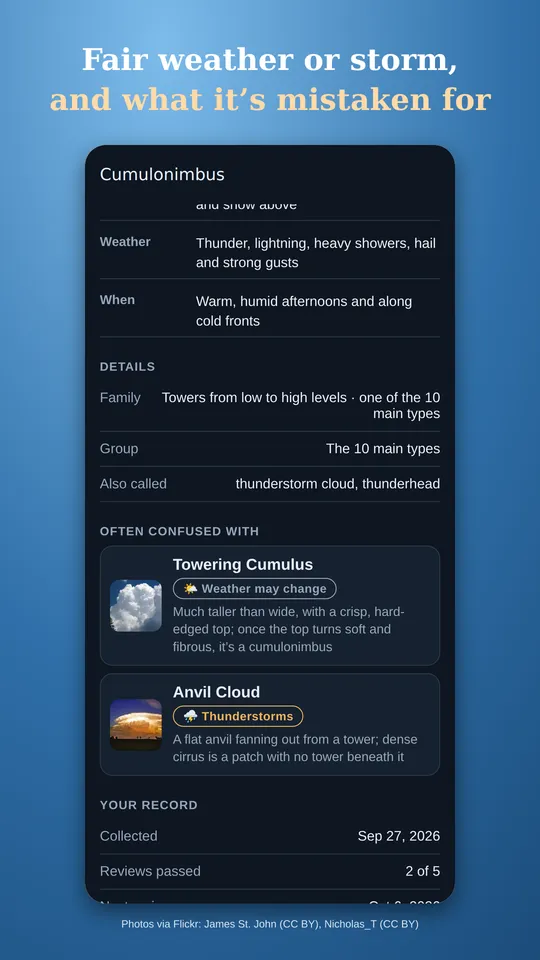
Every cloud shows the weather it usually brings: fair, changing, rain or snow, thunderstorms or danger.
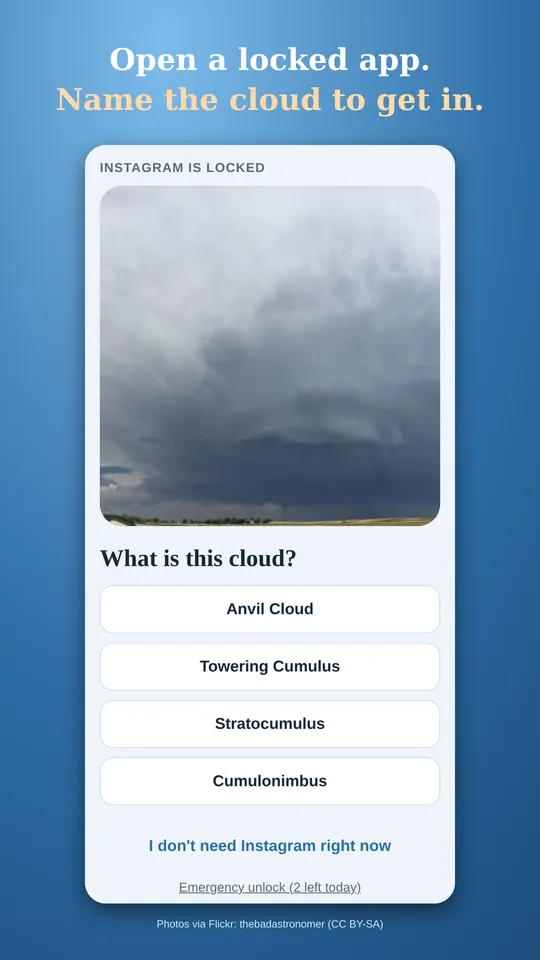
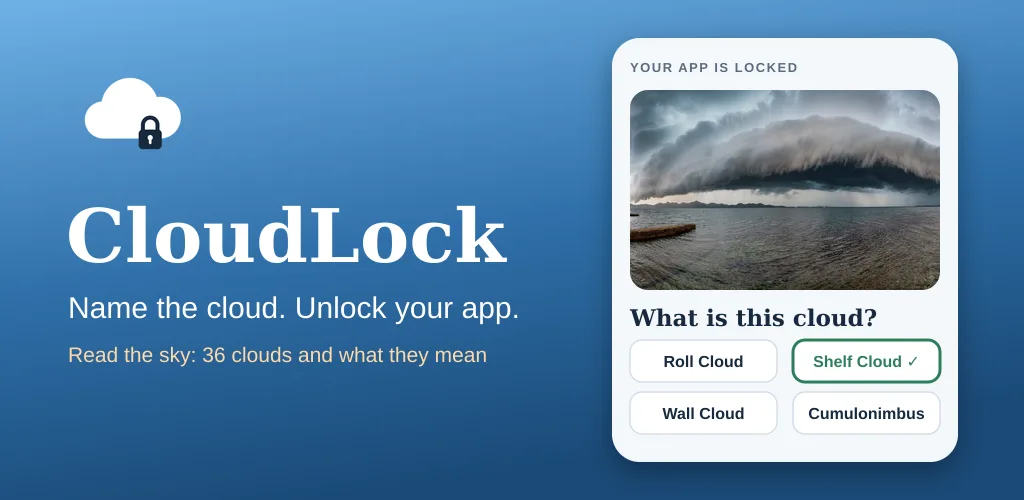
Look up from your phone, literally. CloudLock turns every urge to scroll into a glance at the sky: a locked app shows a cloud photo and four names. Get it right and you’re in; get it wrong and you learn the difference, and what weather it means.
Free · no ads · works offline · Android 8 and later · Privacy · Terms
Clouds hint at the weather, but only your local weather service can warn you about storms. If a funnel, wall or shelf cloud is heading your way, go indoors. CloudLock says this in setup and on every cloud.
An app blocker with its head in the clouds. Five seconds of sky-reading before every scroll.
Pick any Android app: social media, video, games. Choose how many new clouds to learn each day.
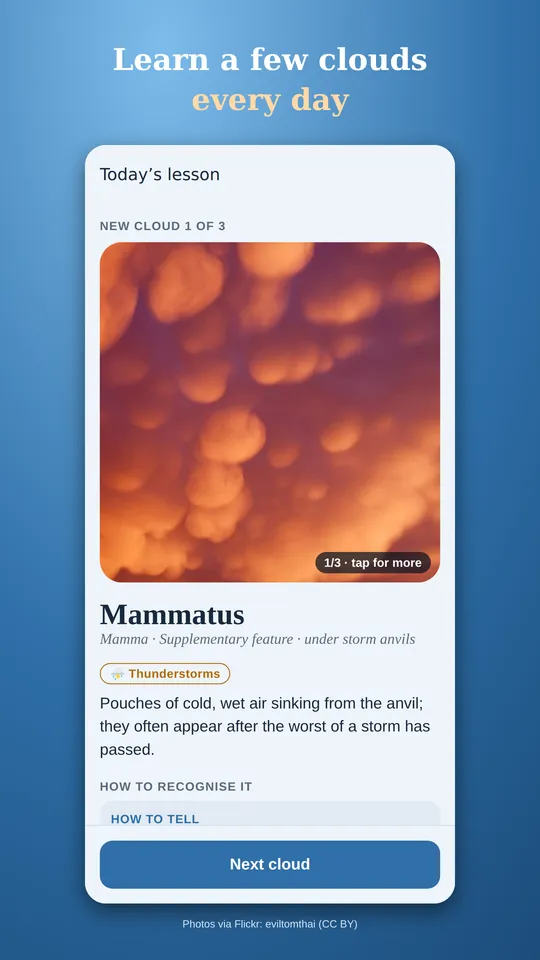
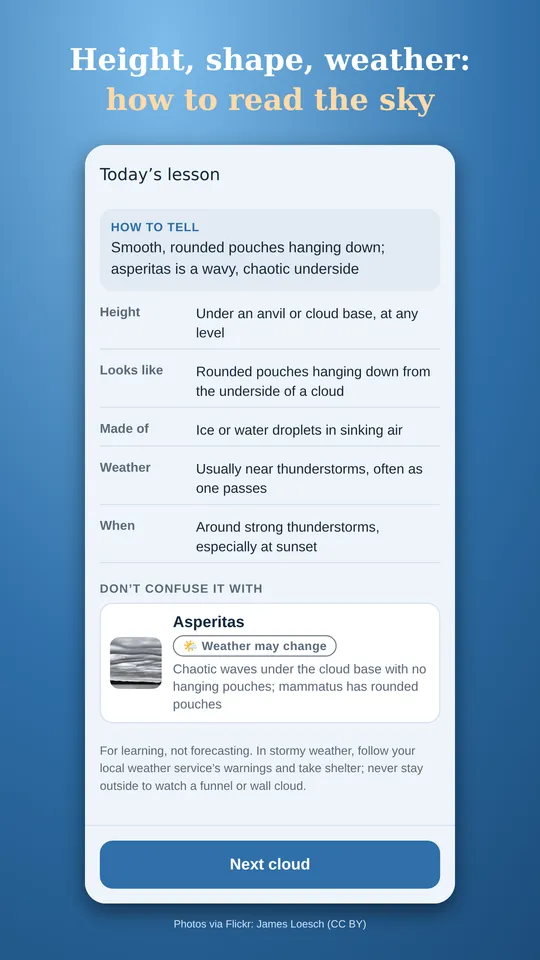
Short lessons with real photos, how high each cloud forms, what it’s made of, the weather it brings and what it’s mistaken for.
Open a locked app and CloudLock asks about one of your clouds. Right: the app opens for 10 minutes. Wrong: a short pause to learn the difference.
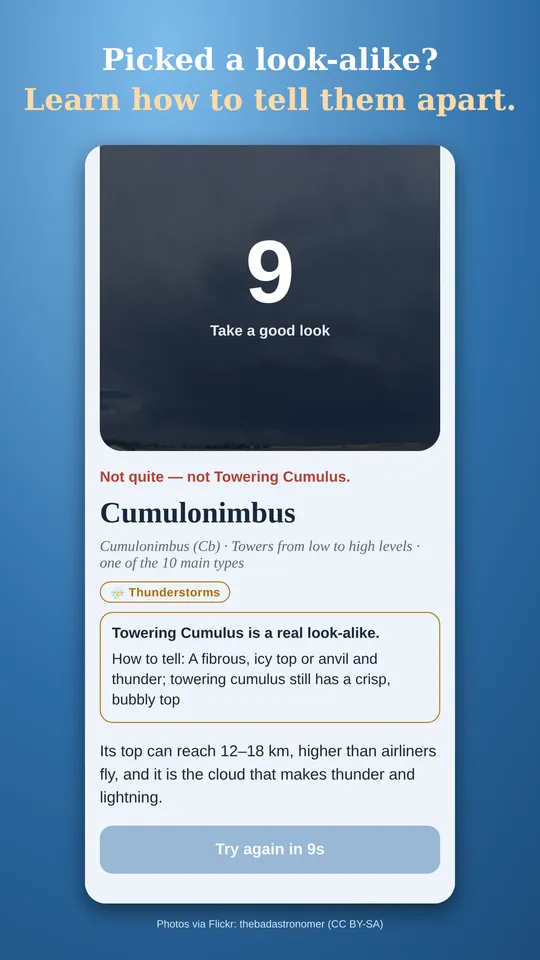
The hardest part of cloud spotting is telling similar clouds apart, so that’s what CloudLock drills. Like the classic test meteorologists use: hold your arm out and compare the cloudlets to your hand.
Grains smaller than your fingertip, with no shading. High, icy and short-lived.
Cloudlets about a thumb wide, shaded on one side. On humid mornings, storms may follow.
Clumps bigger than your fist, joined in a lumpy layer. The most common cloud on Earth.
Every cloud shows the weather it usually brings: fair, changing, rain or snow, thunderstorms or danger.
Height, shape, ice or water, when it appears, and the one feature that gives each cloud away.
The wrong answers are the clouds people actually confuse, and a wrong pick explains how to tell them apart.
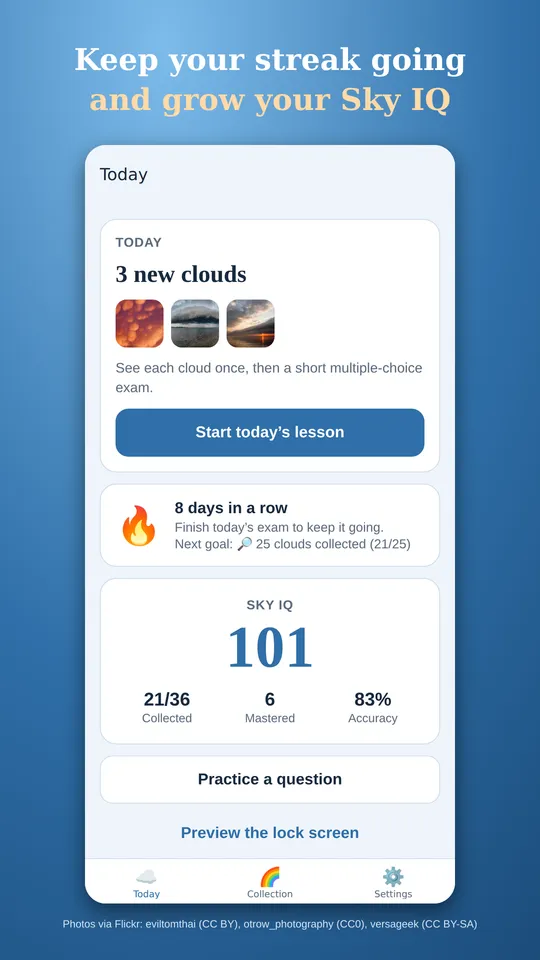
Each cloud returns after 1, 3, 7, 14 and 30 days until it’s mastered. Miss one and it starts again tomorrow.
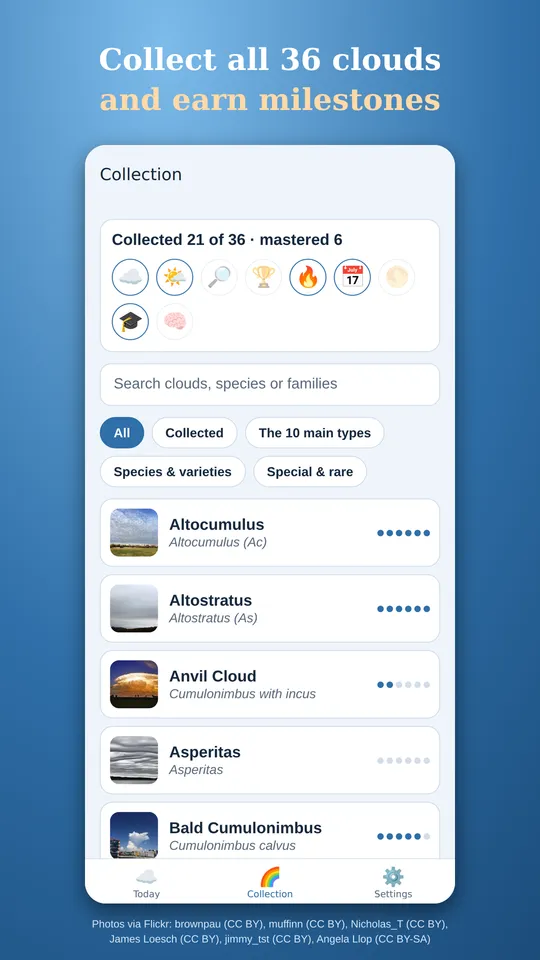
Fill your collection, build a daily streak, earn milestones and grow your Sky IQ from 60 to 160.
No account, no ads, no analytics. Everything stays on your phone and works offline.
Real photos from Flickr photographers, credited in every image.
From the WMO International Cloud Atlas, the reference meteorologists use.
Cumulus, stratocumulus, stratus, nimbostratus, altostratus, altocumulus, cirrus, cirrocumulus, cirrostratus and cumulonimbus.
Fair-weather and towering cumulus, mares’ tails, lenticular and turreted altocumulus, the bald cumulonimbus and the anvil.
Mammatus, shelf, roll, wall and funnel clouds, virga, fallstreak holes, wave clouds, asperitas, noctilucent and mother-of-pearl clouds.
No subscription. Pay once if you want more, or never.
| Free | CloudLock Plus (one-time) | |
|---|---|---|
| Locked apps | Up to 2 | Unlimited |
| Clouds | The 10 main types | All 36, including species and special clouds |
| Lessons, reviews, streaks | ✓ | ✓ |
| Ads or tracking | None | None |
CloudLock is an app locker for Android. When you open an app you locked, it shows a cloud photo with four names, usually including its real look-alikes. Name it correctly and the app opens for 10 minutes.
36 clouds from the WMO International Cloud Atlas: the 10 main types (cumulus, stratus, cirrus, cumulonimbus and the rest), their best-known species such as lenticular and towering cumulus, and special clouds like mammatus, shelf clouds, noctilucent clouds and fallstreak holes.
No. It teaches what clouds usually mean, which is useful and fun, but only your local weather service can warn you about storms. In stormy weather, take shelter.
Yes. The free version locks up to 2 apps and teaches the 10 main cloud types. CloudLock Plus is an optional one-time purchase that adds unlimited apps and 26 more clouds. No ads, no subscription.
No. Everything stays on your phone: no account, no analytics and no ads. It works offline. Read the privacy policy.
CloudLock is almost ready for Google Play.